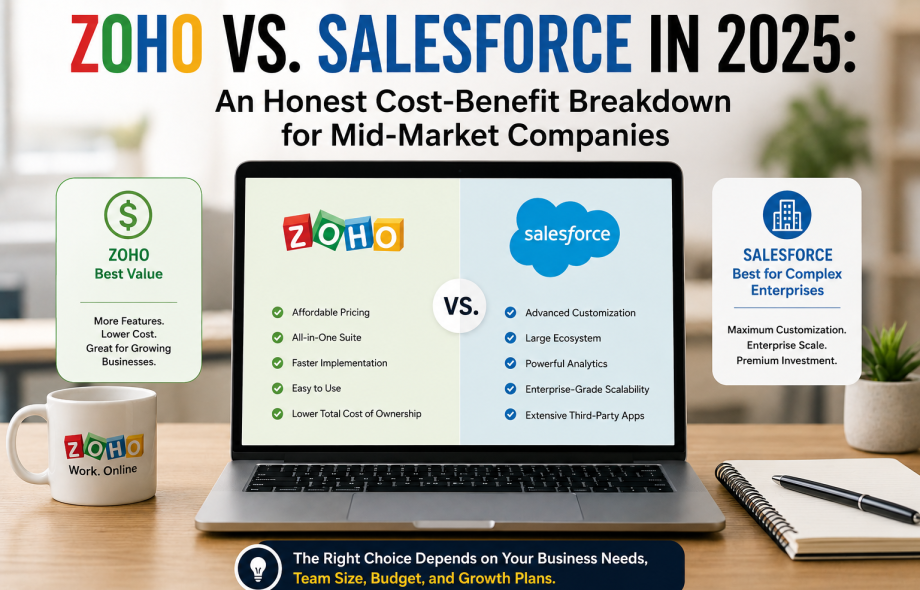
All mid-market businesses will have this discussion at some point. The sales team is past the point of using spreadsheets. The CRM that used to be OK with 20 users now is struggling with 50 users. I’ve heard about Salesforce, I’ve heard that Salesforce is expensive, and I’ve heard of someone who pulled up this pricing page from Zoho and it seems almost too good to be true. The meeting continues until someone decides to “do a proper comparison.
This is that comparison, for companies with between fifty and five hundred employees, who have made a real decision, not a theoretical one.
The honest starting point: what you are actually comparing
Salesforce and Zoho are not the same product in different skins. They have some superficial resemblances, such as being cloud based CRM platforms with integration, reporting and sales automation, but they were created to meet different customers’ needs and have taken different paths of development.
Salesforce is designed for enterprise. That’s reflected in its architecture, its customization model, its partner ecosystem, and its pricing. It’s quite powerful, quite flexible, and quite complex! That complexity is a worthwhile investment for large organizations with an established Salesforce admin, development team, and budget.
Zoho was designed to be the business operating system of enterprises which can’t afford or don’t want to use ten different enterprise solutions. It’s a bit more wide-ranging, more self-contained in its environment, and comes with a price tag based on the assumption that the person who is supposed to put it into practice may be on top of three other duties.
Here are the interesting middle companies, the mid-market. You can’t afford not to have serious tooling. Too skim on fat to cover the Salesforce’s total cost of ownership. The first place where comparisons need to be done is understanding the true cost of ownership.
The real cost of Salesforce for a mid-market company
Salesforce’s pricing model is per-user per month, which seems reasonable until you add up what you really need. The Sales Cloud Professional edition runs around $80 per user per month. Unlocking workflow automation, enhanced reporting and API access, Enterprise is approximately $165 per user per month. Unlimited is $330.
A sales and operations team of 50 people costs a bit more than $99,000 in license fees per year for Enterprise tier. Implementation is estimated to be $30,000 to $150,000 for a mid-market Salesforce implementation, and that’s not included in that number. It excludes the continuous administration, the vast majority of mid-market companies that use Salesforce are serious about this, and either have a dedicated admin or pay a partner for managed services. Not to mention the additional functionality that is often required, such as CPQ, Marketing Cloud, Service Cloud, and integration with Salesforce that aren’t included.
When a mid-market company is actually using Salesforce at the extent that they require, the total cost of ownership can range from $150,000 to $400,000 per year. That investment is worth it for some companies for the results. To some it is just not a logical number.
The real cost of Zoho for the same company
Zoho One, which provides access to all of Zoho’s other applications – including CRM, Books, Desk, Campaigns, Analytics, Projects and more than 40 other apps – is about $37 per user per month on an annual basis. This is about $22,200 for each team of fifty.
Zoho CRM Professional Edition provides a subset of the features and is approximately $20 per user per month while the Enterprise Edition is approximately $40 per user per month. At fifty users, Enterprise only costs $24,000 per year; a portion of what something like that configuration with Salesforce would cost.
The cost of implementation is also much lower when it comes to Zoho. If you have an experienced team, they can deploy a simple Zoho CRM system including workflow, pipeline and basic reporting functionality within 2-4 weeks. The more complex answers that involve Zoho One in more than one department generally cost from $8,000 to $40,000. Businesses can expect the investment in implementing to be paid back in the first year, just for the license savings, with Zoho Consulting Services.
Where Salesforce genuinely wins
As a point of clarity, saying this is important because otherwise there is no way to actually be honest with a comparison: In some use cases, Salesforce will be a more powerful platform, so claiming otherwise would be a mistake.
Salesforce’s level of customization is greater. When you have a company with very complex sales processes, such as multi-tiered channel partner management, complex CPQ needs, complex territory hierarchies with revenue attribution, or deep integration requirements with legacy enterprise systems, Salesforce’s architecture can handle those complexities that Zoho can’t.
Salesforce’s AppExchange is also more comprehensive. There are thousands of pre-built integrations and industry-specific apps developed on Salesforce that don’t have Zoho counterparts. It has an impact on companies in regulated industries that have compliance tooling requirements and companies that are already using Salesforce but not Zoho in their software.
Salesforce’s reporting and analytics features on the high end are quite advanced, especially when paired with Einstein Analytics. When a business has many objects in its data volumes and sophisticated cross-object reporting needs, it makes a difference.
Where Zoho genuinely wins
For most mid-market businesses, price isn’t the only reason to choose Zoho.
The Zoho integration story is an interesting one. In fact, CRM, billing, support, email marketing and analytics all reside within Zoho, sharing data without having to rely on custom integration. Any deal that is created by the customer in Zoho CRM is fetched automatically into a support ticket created in Zoho Desk. An invoice generated in the Zoho Books integrates with the respective contact in the CRM. Zoho Campaigns allows you to create a marketing campaign based on the real-time CRM data. This degree of native integration in a Salesforce environment usually takes several other products and a lot of development.
Another thing that Zoho does better is that it can be used quickly and effectively. In weeks, a mid-market company can transition from signing a contract to implementing a working CRM system with automated pipelines, custom fields and basic reporting. Typically, it takes three to six months for Salesforce-based deployments to reach a similar level of functionality, and they need to be attended to by experts who may not be available on the internal team.
This difference in administrative overhead can be substantial and is frequently overlooked when making a decision. Salesforce is a tool that needs to be managed accordingly for it to be well configured. Not all team members need to be full-time CRM administrators and that’s not a minor point in the case of smaller, mid-market teams.
The questions that actually determine the right answer
The one way to look at the situation is to identify a set of questions to help quickly determine which platform is best for a given company, rather than to declare a winner.
Is your sales process really that complicated? Most mid-sized businesses say that their sales process is complicated when it’s actually multi-stage and with some conditional logic. This is a level of complexity that Zoho can do. When parties are involved with complex revenue recognition, channel programs with multiple levels, and configure price quote, it begins to tip in Salesforce’s favor.
Who is your team made up of? When there’s a separate operations staff and a round of money for implementation and maintenance, Salesforce’s capabilities are attainable. If you’re a lean team with the same individual owning CRM and three other systems then it’s a realistic option.
Which software infrastructure are you currently using? That integration reality is more important than any price comparison if your company relies on tools that have deep Salesforce integrations that don’t have Zoho alternatives.
Where do you see yourself in 3 years? While Zoho has more than a hundred users, it has been expanding its enterprise functionality. Salesforce grows to the thousands. But if a company has a definite enterprise scale path in the very short term, then that should factor into the decision.
The bottom line
But for most mid-market businesses, those with significant operational needs but limited team size, real growth goals, but limited budgets, Zoho offers a more realistic return on investment than Salesforce at a lower overall cost.
It’s not a criticism of Salesforce. It’s a recognition that a platform designed for enterprises, supported by enterprise budgets and enterprise implementation resources is not always the right choice for a company that’s not (quite yet) at enterprise size.
It is found that the companies which opt for Zoho and make the best out of it invest in their implementation process. They collaborate with expert Zoho Consulting Services teams that are intimately familiar with the platform, allowing them to set it up around real business processes and not demo processes. They do not take the migration and set it up as a “lunch time job”. In the end, they come up with a system their teams can use and that’s the only thing that really counts.
A well-tuned CRM, that is never opened, is a lot less useful than a well-fitted CRM that is used by an actual team.
 :
: